
 NDLink
Conflict in the Niger Delta rarely begins with violence.
It starts quietly, with whispers in marketplaces and riverbanks, disputes over land boundaries, frustration among unemployed youths, mistrust between neighbours, or misinformation spreading faster than truth on social media.
For decades, many of these tensions escalated because something vital was missing; trained and trusted local actors able to detect warning signs early and respond before violence erupts.
That gap inspired the Foundation for Partnership Initiatives in the Niger Delta (PIND) to launch the Niger Delta Peace Champions Programme in 2022; an initiative designed to
equip young leaders across the region with practical peacebuilding skills, conflict early warning knowledge, and community-driven solutions.
Since inception, more than 360 young people across Delta, Bayelsa, Ondo, Abia, Cross River and other Niger Delta states have been trained and mentored to serve as grassroots peace actors.
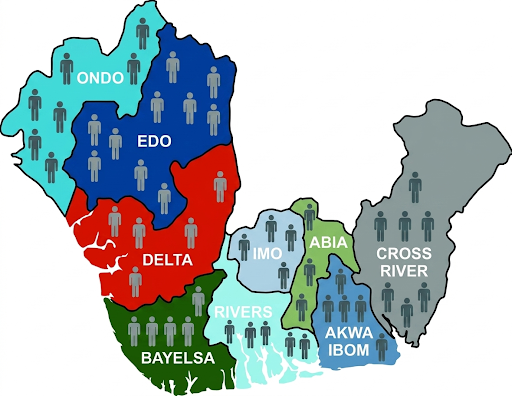
By 2025, the fourth cohort brought together 90 young participants selected from thousands of applicants, including students, entrepreneurs, artisans, advocates, journalists, community mobilizers, volunteers, and persons living with disabilities—united not by profession, but by a shared desire to stop violence before it begins.
What emerged was not merely a training programme.
It became a mindset shift.
Inside the Hall: Where It All Began
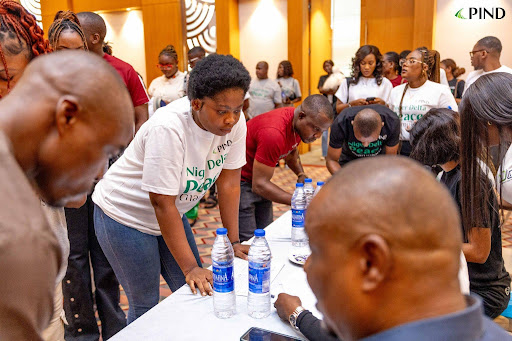
Participants arriving and registering for the day’s sessions
When we arrived for the training in Akwa Ibom in May 2025, what stood out was not only the modules which covered leadership, volunteerism, mindset change, mediation, conflict mapping; but the atmosphere inside the hall itself.
Diversity and inclusion were not slogans; they were visible realities.
Young men and women from different states and backgrounds sat side-by-side exchanging ideas. Participants with hearing impairments followed discussions through sign language interpreters positioned strategically; not as an afterthought, but as a deliberate commitment to inclusion.
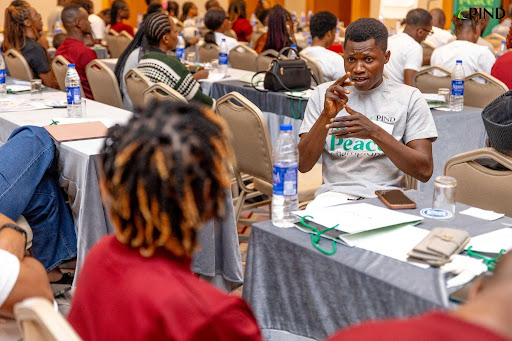
A sign language interpreter and peace champion facilitating communication during a training session.
For many participants, including myself as a journalist, that moment quietly redefined what peacebuilding looked like. It no longer seemed like an abstract policy language or diplomatic negotiation. It was practical, human, accessible.
During one simulation exercise, participants were tasked with resolving a staged conflict. The lesson became immediately clear: there is rarely only one way to calm tension.
“That activity taught me the importance of listening, patience, and teamwork,” a participant, Simon Mohe recalls.
As facilitators emphasized, peacebuilding begins with observation, listening, trust-building, and sustained engagement.
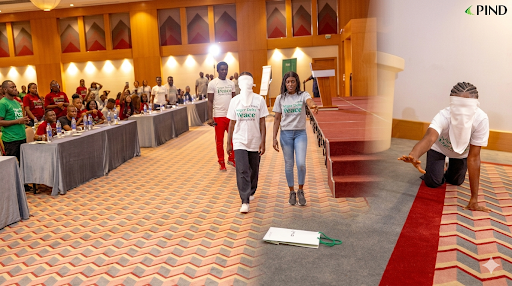
Peace Champions participating in group exercises on listening, collaboration, and trust-building during the 2025 training.
The training also introduced participants to PIND’s Conflict Early Warning and Early Response (EWER) system; an SMS-based platform allowing trained peace actors to report emerging risks in real time.
Months later, those lessons had moved beyond the training hall and into real life, materialising in unexpected places: tailoring shops, football fields, community meetings, youth gatherings, and even online conversations.
When We Returned Home
Across the region, Peace Champions returned home carrying the same question:
What does peacebuilding look like in everyday life?
For Simon in Cross River State, the answer emerged gradually within days, weeks, and months after the training. He now hears something he never expected:
“It’s because of you… If not for you…”
“Whenever an argument is about to start and I step in, people often calm down once they see me,” he said. “After talking to them briefly, I usually hear comments like ‘it’s because of you’ or ‘if not for you.’”
He laughed softly while reflecting on how unexpected that recognition felt.
“Honestly, I never imagined people would begin to see me that way before joining the PIND training. The programme changed my mindset. I realized ordinary people can prevent conflicts every day.”
That realization has since guided his actions; separating fighting community members, mediating disagreements, and maintaining neutrality even when one party is a close friend.
The same shift occurred hundreds of kilometres away in Delta State, though in a completely different setting.
Inside her sewing space, fashion designer Ken-Erhimu Fejiro began applying lessons from mindset change discussions during the training.
“Before this programme, I thought peacebuilding simply meant avoiding conflict,” she explained. “Now I understand it is about creating opportunities that prevent problems.”
Instead of waiting for tensions among idle youths to escalate, she opened her tailoring space to teenagers willing to learn skills free of charge.
“It made me see that giving young people direction is also peacebuilding,” she said.
Elsewhere, the work required patience rather than immediate acceptance.
In Umuahia Abia State, Daniel Obioma initially struggled to be taken seriously.
“Some people called me a small boy,” he says. “They would ask, ‘Who are you to tell us what to do?’”
Rather than withdraw, he listened more than he spoke, gradually building trust through respected community leaders. When misinformation circulating online threatened to spark youth tension around a local meeting, Daniel verified the claims, engaged stakeholders, and clarified the facts before confrontation could begin.
“Some people now call me Mr. Peace,” he said with a smile.
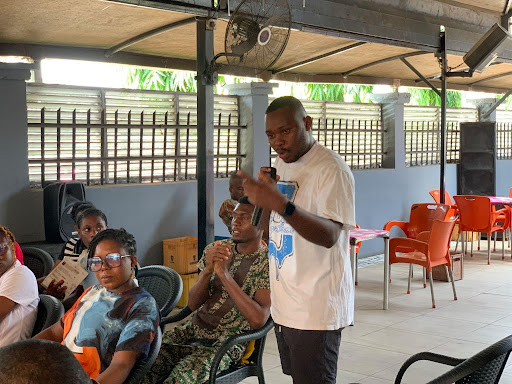
Daniel facilitating dialogue among community members;an example of grassroots mediation helping resolve tensions before they escalate into violence.
The transformation repeated itself in different forms across states.
In Bayelsa’s Amassoma community, Opuene Ebitimikondei discovered that peacebuilding sometimes begins with overcoming language barriers.
“One of my biggest challenges was that many elderly people didn’t understand English,” he explained. “I had to find interpreters before dialogue could happen.”
Yet mediation still succeeded. A brewing domestic dispute among siblings was resolved before escalation; an example of intervention at the earliest stage of conflict.
In Arogbo, Ondo State, AFUN Joseph began approaching peacebuilding differently after the training.
“I used to think peacebuilding was just stopping fights,” he said. “Now I know it is about addressing root causes before conflict even starts.”
He described the Peace Champions network itself as one of the programme’s strongest outcomes.
“We realized we are not working alone. There is a whole network supporting peace.”
Early Warnings, Real Impact
Long before he joined the programme, Joshua Adeyemi had already learned what happens when warning signs are ignored.
“There was a time I reported an issue, but nothing was done,” he recalls. “The warning signs were there. The concern was ignored, and eventually it escalated into a confrontation where I was physically assaulted and threatened.”
He said the incident happened in a sports environment. It left more than bruises; it left questions. Why do people wait until things explode? Why is reporting not enough?
Exposure to PIND’s EWER system later reframed that experience.
“Through the training, I now understand why follow-up and stakeholder engagement matter,” he explained. “Reporting alone is not enough. Now I document, follow up, and engage the right people so issues don’t escalate.”
The lesson echoed elsewhere.
In Isoko North during the Ozoro festival, Noble Agege watched misinformation spread dangerously online.
“Media platforms began calling it a ‘rape festival,’” he said. “That narrative could have created serious tension.”
Using the EWER system, he submitted verified reports highlighting risks without inflaming emotions, helping redirect attention toward accurate information rather than sensationalism.
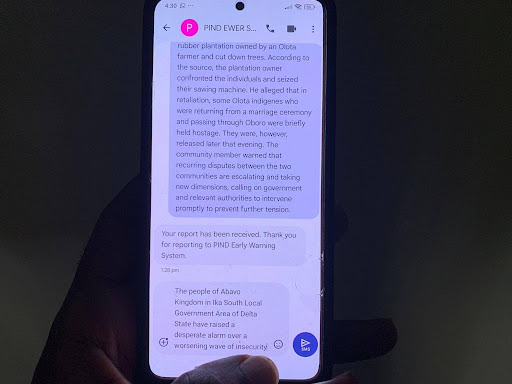
A Peace Champion sending out early warning reports via mobile phone
For Temple Halliday, a social impact advocate living with a physical disability, peacebuilding once felt unreachable.
“Before joining the programme during the 2024 cohort, I thought peacebuilding was something only the United Nations could do,” he says. “You had to be powerful. You had to have arms. I never imagined I could build peace using my mobile phone.”
The EWER system changed that perception.
Despite mobility challenges, Temple began collaborating, facilitating dialogue digitally, guiding youth discussions through messaging platforms and social media engagement.
“You don’t need everything to drive change,” he said. “With little, you can do so much.”
Equally significant was the support system built into the Peace Champions framework. Participants who consistently report early warning signals through PIND’s Integrated Peace and Development Unit (IPDU) SMS-based EWER platform receive modest airtime support; a practical recognition that peacebuilding requires resources, consistency, and sustainability, not just goodwill.
Rethinking Conflict Reporting
For me, the programme reshaped journalism itself. Conflict reporting began to feel incomplete when it focused only on breaking news, damage, or confrontation, without equal attention to prevention, community engagement, and the quiet efforts that stop violence before it begins. The ethical principle of Do No Harm gradually moved from theory into daily newsroom practice, becoming a guiding lens for how stories are assessed and framed.
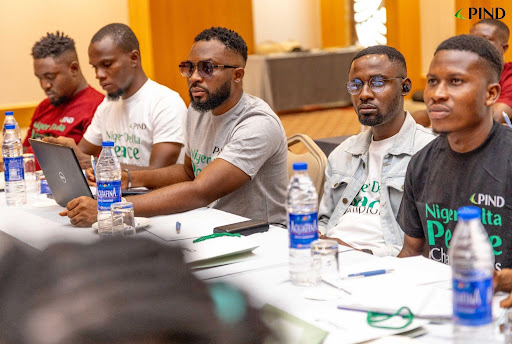
Storytelling for peace …
Chukwuemeka Paschal of Afia TV and Onwuka Kingsley of Rapid FM, both Peace Champions from the same training cohort, and I shared a growing conviction that conflict stories are incomplete when they end at disruption. That perspective has since shaped our field reporting, with greater attention to resilience: communities rebuilding trust after tension, individuals mediating disputes before they escalate, and local structures holding fragile peace together. Increasingly, our work has leaned toward solutions journalism, focusing not only on what is broken, but on what is working or should work to prevent further breakdown.
Beyond the newsroom, I began to reflect more deeply on where peacebuilding truly starts. If conflict can be learned through prejudice and division, then peace too can be taught intentionally from an early age. This conviction inspired peace advocacy efforts in classrooms through engagements with schoolchildren during ethnic and cultural day activities in one of the schools where I volunteer.
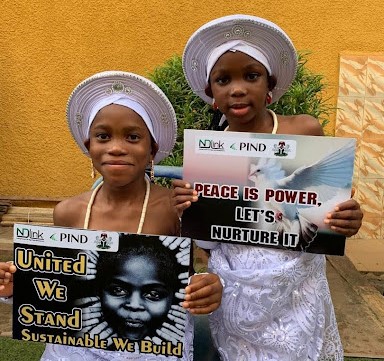
Girls dressed in white to illustrate not just culture, but purity and peace
Through storytelling, discussions, and cultural displays, pupils from different backgrounds were encouraged to see diversity not as a threat, but as a shared strength. It became a simple “catch-them-young” approach to promoting unity, tolerance, and peaceful coexistence. Those moments reinforced the belief that sustainable peace begins with young minds.
For Peace Champions selected for PIND’s 2025 Peacebuilding Outcome Monitoring exercise, the engagement further deepened field experience. The exercise was designed to collect data that would provide insight into the impact of PIND’s 2024/2025 peacebuilding interventions implemented through the Partners for Peace Network and the EU–Niger Delta Community-Based Violence and Criminality Transformation project across communities in the nine Niger Delta states. As enumerators, we moved across these communities within our respective states of residence, conducting Key Informant Interviews and Focus Group Discussions that offered firsthand insight into how these interventions are shaping local realities. A key focus of the exercise was to assess whether communities were now able to carry out their social and livelihood activities more freely, as a result of the relatively peaceful environment the interventions may have contributed to. This process provided a deeper understanding of community dynamics, conflict sensitivity, and the lived impact of peacebuilding efforts at the grassroots level.
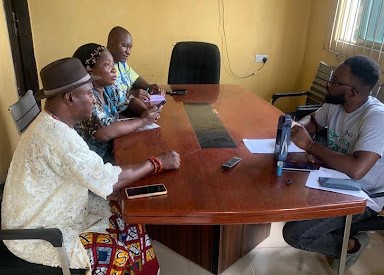
A Peace Champion conducting Focus Group Discussion during the 2025 Peacebuilding Outcome Monitoring Exercise
The experience strengthened grassroots networks that now support more informed, solution-oriented reporting, particularly in areas linked to conflict sensitivity, governance gaps, and community resilience. It also reinforced the importance of documentation that goes beyond narration to evidence-based storytelling that can inform action.
Challenges Along the Way
Despite visible progress, peacebuilding remains complex and often unpredictable.
“It’s hard when people are very angry,” Simon admits.
Fejiro adds, “Some don’t like to be corrected.”
Their experiences reflect a broader reality across communities where emotions can override dialogue, and mediation is often the first casualty of tension.
Across different settings, Peace Champions continue to navigate anger, mistrust, misinformation, language barriers, generational skepticism, and limited resources. In some cases, early warnings are clear but ignored; in others, intervention is delayed because communities are not yet ready to listen. Young mediators are sometimes dismissed, their intentions questioned, or their authority undermined simply because of age or perceived inexperience.
Even when intervention is possible, timing becomes critical. Peace actors often have to step back temporarily, allowing emotions to settle before meaningful dialogue can take place.
“Building trust takes time,” Daniel reflects.
Yet over time, what initially feels like resistance has become part of the learning curve. Patience is no longer seen as delay, but as strategy. Listening has become as important as speaking. And across all the different experiences, one pattern stands out clearly: persistence is not optional; it is the work itself.
What Peace Champions Say Must Come Next
Months after the training, reflections among participants consistently converge around a shared concern: the work cannot end at a single workshop. “This programme is too important to end after one workshop,” Daniel insists, a sentiment echoed across cohorts and states.
For many Peace Champions, the emphasis has shifted from training to continuity. They call for sustained mentorship that extends beyond the initial engagement, deeper community-based practice where lessons are tested in real situations, and stronger collaboration between Peace Champions and local authorities who play key roles in conflict response. There is also growing demand for practical support to help young peacebuilders turn ideas into small, local initiatives that can survive beyond training spaces.
Equally important is the need to expand early warning networks so that more communities are covered and more risks are reported before they escalate. For participants, the argument is simple: without sustained engagement, momentum risks fading. With it, however, the programme has the potential to translate into long-term stability rooted in local action and continuous learning, especially as it gears up for next cohorts of Peace Champions.
A Quiet Movement Growing Across the Niger Delta
Today, the Niger Delta Peace Champions Programme is no longer just a capacity-building initiative. It has become a quiet network of everyday citizens intercepting conflict long before it becomes visible.
Someone pauses to verify before forwarding a rumour.
Someone steps into tension with calm instead of force.
Someone chooses dialogue over withdrawal.
Someone reframes a dangerous narrative before it spreads.
Someone redirects idle energy into something constructive.
Across the Niger Delta, these small, deliberate actions are accumulating into something larger than individual effort. They are slowly reshaping how conflict begins; and how it is stopped before it ever finds its way into headlines.